Chapter 4: Separated into Existence
Physics says that the greatest possible speed of communication is the speed of light. It is fast —seven times around the world in one second— but not infinitely fast. And physics says that no object can reach that speed, nor can any message exceed it.
But let us suppose that messages can exceed it. In fact, let us explore what would happen if we could send messages not merely faster than light, but at infinite speed.
It’s really not hard to imagine: It would mean that I would start receiving your message while you are still forming it in your mind. Of course, this would require that different parts of our brains could also communicate instantly with each other. For the sake of argument, let us allow even that.
All this might sound like frivolous speculation, but it raises an interesting question: Could individuality exist if communication were instantaneous?
Think about it: If your thoughts formed in my mind at the same time as they were forming in yours, whose thoughts would they be? If all brain functions in both our brains were thus connected, we could no longer speak of two separate minds. If you were on a beach somewhere, I would also be on that beach. If I were climbing a mountain, you would also be climbing. Our perceptions would inevitably combine into a single peculiar scene. This reasoning readily extends to any number of minds similarly connected, conjuring up a vision of existence without communication as such, a single reality beheld by a single consciousness.
Luckily, it is not the case for us and our reality, and maybe it’s not simply by luck. Physical laws, particularly those of special relativity, seem to be specifically formulated to limit communication speed, thus safeguarding the reality we know.
Nevertheless, the idea of instant communication does not seem particularly alien. We may even feel that we experience it daily: We flip a switch, and as far as our perceptions go, the overhead lamp comes on instantaneously. We place a call to someone far away, and a conversation ensues without noticeable lags. We know that the lags are there, of course, only too small to notice. So we tend to ignore them as if instantaneous communication were the norm, not something capable of merging separate minds into one.
The reverse scenario of splitting a single mind into several provides another way of understanding the origin of the mandate and of its underlying structure. And so, we leave the idea of instantaneous communication behind and re-enter the reality we know, governed and shaped by the Mandate.

The finite speed of communication can be a natural entry point into the study of the mandate, since the formula at the core of the mandate was originally devised to quantify communication between the separate entities of sender and receiver. (Incidentally, neither entity needs to be conscious; in fact, the bulk of today’s communication occurs between unconscious devices.)
At the core of communication is the concept of message, which includes more than the restricted class of spoken and written messages. In general, we can think of messages as answers to explicit or implied questions. For example, when we glance at a clock, we are actually interrogating it, and the message we receive is the time of day: a selection from a finite set. Depending on the clock, the size of the set can be 12 (readout to the nearest hour), 720 (to the nearest minute), or 43,200 (to the nearest second.)
To see how such aspects apply to communication between humans, let us consider a scenario from the age of Classical Greece.
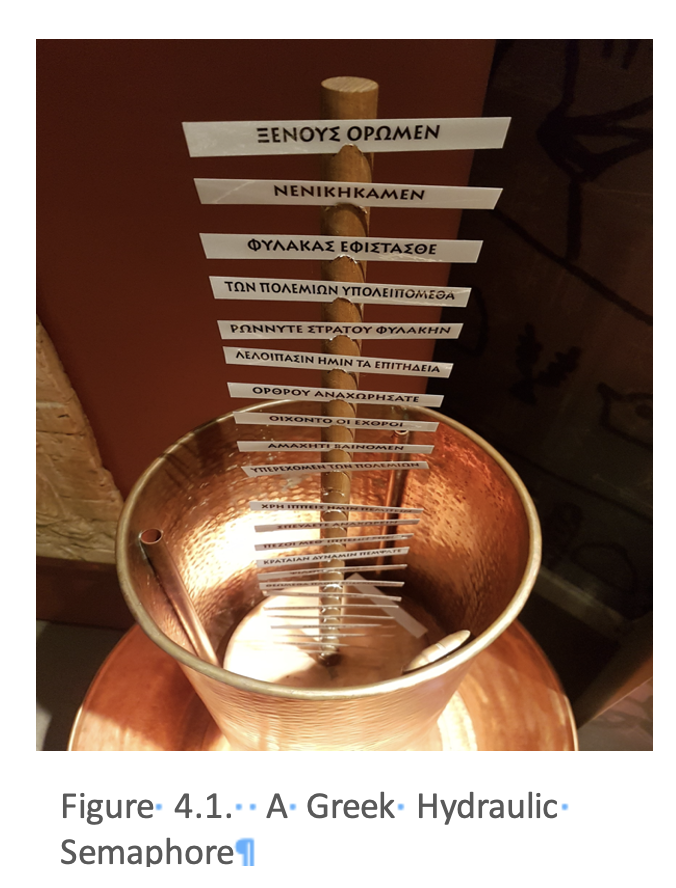
Two allied army units are out on a military campaign. They want to stay in touch with each other, and their communication officers decide on a system similar to the Greek hydraulic semaphore [1]. Only, in their particular version they make use of graduated glass vessels with duplicate message lists affixed to them. The transmission medium is a liquid, whose level in the vessels indicates the intended message.
Now, say that one of the army units spots hostile troops sneaking up on the other unit. The communication officer would first select the appropriate message by filling the encoding vessel up to the level labeled: ‘Enemy force approaching’. Then, he would pour the vessel’s content into a shipping vessel, like a wine skin.
A courier would then deliver the medium to the allied camp, where it would be decoded by the reverse process. As a bonus, neither the courier nor a potential enemy patrol would be able to decipher the message from the medium alone.
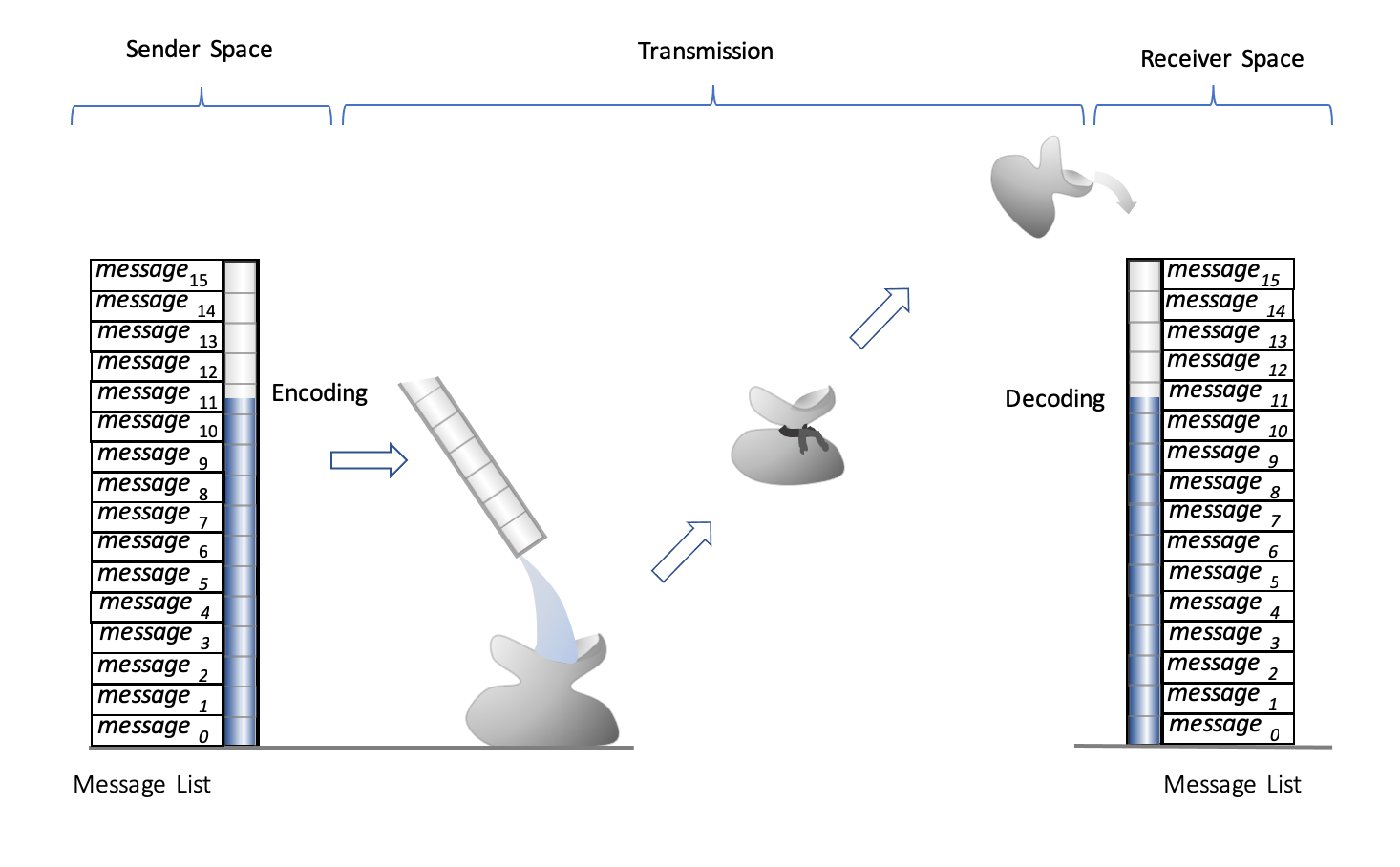
Note again the essential steps: The sender selects a message from a discrete, ordered list of messages, represents its ordinal position with a quantity of medium measured with the encoding/decoding device, and transmits it. The recipient receives the medium, inserts it in an identical encoding/decode device, and the ordinal position is replicated in the recipient’s space.
There is an additional aspect to consider. Usually, messages have meanings associated with them; but, as we saw in Episode 1, Shannon deliberately excludes ‘meaning’ from the process of communication. In The Mathematical Theory of Communication, he first acknowledges that the concept cannot be entirely avoided:
Frequently the messages have meaning; that is, they refer to or are correlated according to some system with certain physical or conceptual entities.
But he immediately follows up with,
These semantic aspects of communication are irrelevant to the engineering problem. The significant aspect is that the actual message is one selected from a set of possible messages.
How do we reconcile the two statements? Perhaps by first clarifying what is and what isn’t transmitted; more precisely, by carefully differentiating between the ideas of transmission, communication, and interpretation.
The transmission phase consists of a quantity of medium transferred from sender to receiver. Recall that the medium itself has no meaning: Examined in isolation, it doesn’t represent any one message, since the same quantity can potentially represent innumerable messages depending on the encoding/decoding system.
Yet, we do know that messages can be communicated and interpreted. Elaborating on Shannon’s words, we see that once we strip away the semantic aspects, communication is essentially the remote replication of an ordinal number. In turn, the number can be associated, by pre-established convention, with a label in an ordered list of labels. Thus, the meaning (or interpretation) is in the label, which is not transmitted, since it is already in place at the sender’s and receiver’s locations.
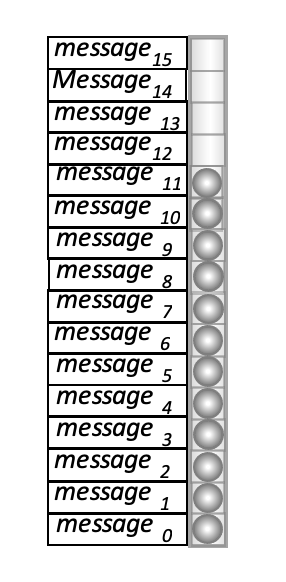
We have seen that the list of selections is discrete even when the medium is not. But the medium can also be discrete, like in the case of identical marbles that can slide-fit into the encoding/decoding vessel (Fig. 4.3). This scheme removes a layer of opacity in the encoding, since the ordinal aspect may be surmised from the numeric quantity of marbles. But if cryptographic strength is not essential, this method is easier to visualize.
From all this, it is evident that the meaning of messages cannot be transmitted. A telling example is when two speakers of different languages attempt to communicate with each other: Words are transmitted in both directions, but no meaning is communicated.
Thus, we can say that
A message replicates a selection in the ordered space of the sender into a corresponding space in the receiver. This is mediated by the communication of an ordinal number transmitted by physical means. For communication to be semantically meaningful, identical ordered sets of possible meanings must pre-exist in the space of both sender and receiver.
Based on these considerations, it is reasonable to conclude that the functional structure of all types of communication, including the verbal kind, is numeric.
But you might say: Surely there must be non-numeric messages! The first army unit could just send a handwritten note to alert the other unit, or simply shout it across the distance. Where would the numeric aspect be then?
Consider that both communication officers would have had similar education, endowing them with matched vocabularies as well as shared meanings for each word. In the case of a handwritten note, whether plain or scrambled, the encoding would consist of alphabetic characters whose numeric aspect may not be immediately evident. Yet, writing usually relies on a number of unique characters listed in conventional order. In European languages, the alphabet starts with A, B, C, D, etc., proceeding with minor deviations all the way to Z.
Thus, the alphabet has an ordinal sequence, with each letter readily substituted by its ordinal equivalent. The same generally applies to spoken messages, with phonetic tokens substituting for alphanumeric symbols. This aspect is even used in rudimentary secret codes.
How do these aspects relate to the mandate? They do through a seemingly secondary aspect: the cost of transmission.
Notice how communicating the 11th message (Figure 4.3) requires more marbles than for the 1st message. The same reasoning extends to more modern means of transmission, like light flashes, electronic pulses, etc. Transmission requires resources such as energy, memory volume, bandwidth, time, etc., often in combination. Thus, it makes sense to arrange the messages in the shared lists such that the average (and thus expected) cost of transmission is minimized. Discovering the optimal arrangement may rely on previous knowledge or on evolving observational statistics.
Let us consider again the case of the two army units.
Initially, the still-naive communication officers might assume that all 16 messages in the example are equiprobable, with . But, with experience, the probability distribution evolves. Messages that are employed more often, like ‘Send supplies’, can be moved to lower locations in both lists, thus minimizing the average use of medium. Conversely, rarer messages like, “The enemy has surrendered”, can be placed higher in the lists, so that their greater use of medium occurs less frequently. Thus, as the skew in the distribution increases with experience, the average cost of transmission decreases.
Does that sound familiar? We have already encountered the topic of skewed probability distributions in earlier episodes, where we learned that the mandate ranks distributions with respect to their entropy, promoting those of lowest entropy (and correspondingly highest skew). This makes the principle of communication efficiency fully consistent with the Mandate. Social culture promotes the sharing of optimized lists among carriers, so that each carrier can start reducing the entropy of its own environment from a pre-lowered level, in an evolving virtuous cycle.
It is commonly said that communication builds bridges between people, allowing for a wide exchange of thoughts, points of view, and knowledge.
As communication efficiency improves, the distance that separate us decreases along many dimensions. We wonder whether the mandate to reduce entropy may in fact reflect another unspoken drive, an unconscious longing for that unity of mind seemingly barred by finite-speed communication.
[1] https://en.wikipedia.org/wiki/Hydraulic_telegraph#Greek_hydraulic_semaphore_system